

Selecting the right Countersunk Head Blind Rivet size is essential for achieving a secure connection, a smooth surface finish, and reliable installation. For manufacturers, engineers, and industrial buyers, the selection process involves more than matching the rivet diameter to a pre-drilled hole. Material thickness, grip range, countersunk hole geometry, material compatibility, and installation conditions must also be considered. Zhejiang Jiaxing Tuyue Import And Export Co., Ltd. offers countersunk head open-end blind rivets designed for applications requiring one-sided installation and a flush finish. Its listed product specifications include diameters from 3.2 mm to 6.4 mm, lengths from 8 mm to 35 mm, steel or stainless steel body and mandrel options, and colored finishes.
Rivet diameter affects the connection's load capacity, hole requirements, and compatibility with the materials being joined. A larger diameter may provide greater resistance to certain loads, but it is not automatically the best choice for every application. Engineers should evaluate the expected tensile and shear loads, substrate strength, sheet thickness, and available installation space before selecting a diameter.
For example, Tuyue's listed diameter range of 3.2–6.4 mm provides options for different fastening requirements. The final selection should match the specified hole diameter and the manufacturer's dimensional tolerances. An oversized hole can reduce joint reliability, while an undersized hole can make insertion difficult or damage the rivet during installation. For production applications, maintaining consistent hole quality is just as important as choosing the correct nominal rivet size.
Choosing the correct Countersunk Head Blind Rivet length starts with measuring the total thickness of all materials being joined. This measurement is commonly called the total joint thickness. The selected rivet must be suitable for that thickness and provide sufficient deformation on the blind side to form a secure joint.
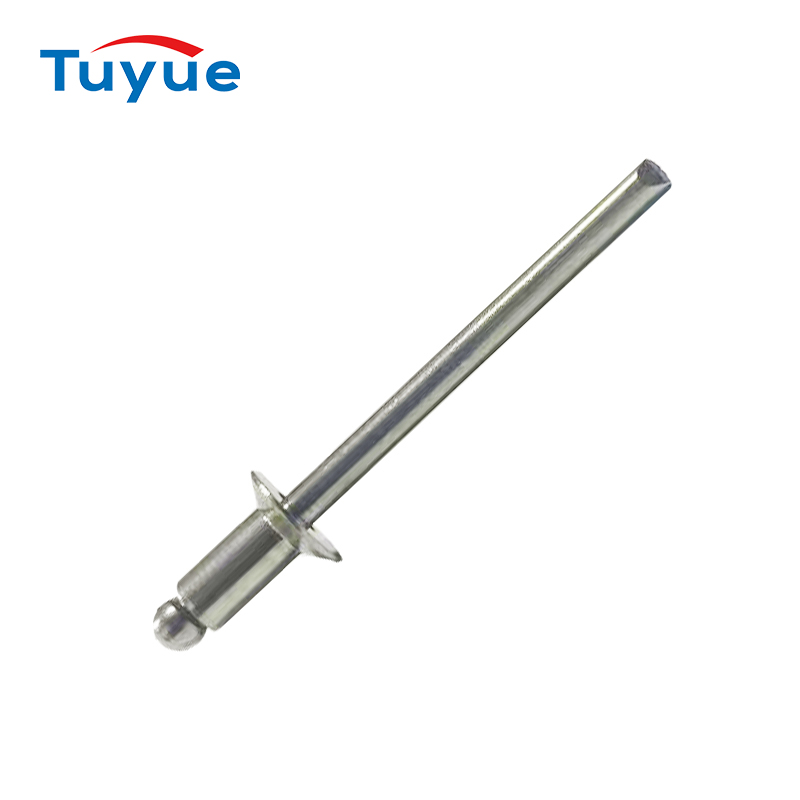
However, nominal rivet length alone does not determine whether a rivet will work. Buyers must also check the manufacturer's grip range, which identifies the material thickness the rivet is designed to clamp. A rivet that is too short may not form the required blind-side head, while an unsuitable longer rivet may not provide the intended joint formation. Tuyue lists lengths from 8 mm to 35 mm, but the available combinations of diameter and length should be confirmed against the specific product specification before ordering.
Grip range is the total thickness of the materials that a blind rivet can reliably fasten within its specified operating limits. It is one of the most important parameters when selecting a rivet for sheet metal assemblies, equipment enclosures, furniture components, or automotive panels.
To determine the required grip range, measure the combined thickness of all layers at the fastening point, including any additional layers that will be clamped by the rivet. Then compare this measurement with the manufacturer's specified minimum and maximum grip values. If the joint thickness falls outside the permitted range, the rivet may not form correctly or may fail to clamp the materials as intended.
It is important to distinguish grip range from nominal rivet length. Two rivets with similar lengths may have different grip capabilities because of differences in body design and dimensions. Buyers should therefore request the grip-range data for the exact rivet specification rather than relying on length alone.
A Countersunk Head Blind Rivet is designed to sit flush with the workpiece surface when installed correctly. This helps reduce protrusions that could interfere with adjacent components, moving parts, surface coverings, or the appearance of a finished assembly. Such a design can be useful for sheet metal fabrication, automotive panels, furniture, and equipment enclosures.
Achieving a flush finish requires the countersunk head to match the prepared hole geometry. Before installation, check the countersink angle, diameter, and depth against the rivet manufacturer's drawing. The hole must accommodate the head without leaving it excessively raised or recessing it too deeply. Excessive countersinking may also reduce the remaining material thickness, particularly in thin sheet metal.
A countersunk blind rivet should not be assumed to fit every countersunk hole. Correct head geometry, hole preparation, and joint thickness must be verified together. Where appearance and surface alignment are critical, a trial installation can help confirm the fit before full-scale production.
Material selection affects mechanical performance, corrosion resistance, service life, and overall fastening cost. Steel blind rivets may be suitable for applications where mechanical strength and cost efficiency are priorities, provided the selected grade and finish meet the operating requirements. Stainless steel is often considered for humid environments, outdoor equipment, and applications where improved corrosion resistance is needed.
Tuyue's product page lists steel and stainless steel options for both the rivet body and mandrel. When selecting a material combination, buyers should consider the expected load, exposure to moisture or chemicals, contact with other metals, and the properties of the materials being joined. Corrosion performance depends on the specific material grade, surface condition, and service environment, so stainless steel should not be treated as universally corrosion-proof.
The surface finish also deserves attention. Tuyue lists colored finishes, which may be relevant when the fastener needs to coordinate with a finished panel or product. Buyers should confirm the available colors, coating specifications, and environmental suitability for the intended application.
Several avoidable mistakes can affect blind rivet installation and joint reliability. The first is choosing a rivet based only on its diameter without checking the total material thickness and grip range. The second is using an unsuitable hole size or countersink geometry, which can prevent the head from seating properly. A third mistake is overlooking material compatibility, especially when different metals are joined or the assembly will operate in a corrosive environment.
Installation technique is another important factor. The rivet should be inserted fully into the prepared hole, and the installation tool must be compatible with the rivet specification. Incorrect tool setup, poor hole preparation, or an unsuitable rivet can lead to incomplete setting, inconsistent head formation, or damage to the workpiece. For production lines, consistent drilling, appropriate tooling, and routine inspection can help reduce assembly defects.
Finally, buyers should avoid assuming that every diameter is available in every listed length. The overall product range is a starting point, not a substitute for a detailed dimensional specification. Confirming the exact combination before procurement helps prevent ordering errors and unnecessary production delays.
Before placing an order, purchasing teams and engineers should prepare a clear specification covering the required diameter, rivet length, total joint thickness, grip range, countersunk head dimensions, body material, mandrel material, and surface finish. Application details such as load requirements, environmental exposure, substrate type, and installation access should also be provided when requesting a recommendation.
For example, a manufacturer assembling a sheet metal enclosure may need a rivet that provides a flush exterior surface while allowing installation from only one side. In this case, the selection process should verify the countersunk head geometry, sheet thickness, grip range, and compatibility with the enclosure material. A prototype installation can then be checked for head seating, joint clamping, and visible surface defects before the specification is approved for volume production.
Zhejiang Jiaxing Tuyue Import And Export Co., Ltd. supplies a range of hardware and fastening products, including countersunk head open-end blind rivets. Its product range is intended to address different fastening requirements through available dimensions and material options. Buyers can consult the official product page and contact the company to confirm the specific dimensions, material combinations, and finish options required for their applications.
Q1: How do I calculate the correct blind rivet length?
Measure the combined thickness of all materials being joined, then select a rivet whose specified grip range accommodates that thickness. Confirm the manufacturer's dimensional requirements before ordering.
Q2: What is the difference between blind rivet diameter and grip range?
Diameter describes the nominal width of the rivet body, while grip range describes the total material thickness the rivet is designed to clamp. Both parameters must match the joint requirements.
Q3: Do countersunk blind rivets require special holes?
Yes. The hole and countersink geometry must match the rivet's specified dimensions and head angle to achieve the intended flush finish. Follow the manufacturer's drawing and installation guidance.
Q4: Can I use a longer blind rivet if the grip range is insufficient?
Not without checking the specification. A longer rivet does not necessarily provide the correct grip range. Select a rivet designed for the actual joint thickness and confirm its dimensional compatibility with the application.


